Quick Answer
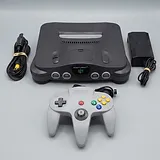
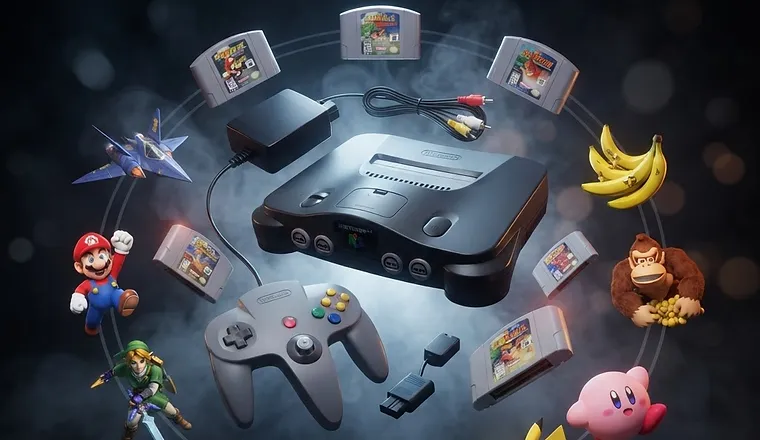
The Nintendo 64 Console Black - (N64) is available at NicestFinds for $149.95 and includes the console, an AC power adapter, and a composite AV cable. It plays all NTSC-U N64 cartridges but requires an AV-to-HDMI adapter for most modern televisions. As of 2026, this is a competitively priced entry point for the N64 library.
Key Takeaways
- The Nintendo 64 Console Black - (N64) is priced at $149.95 and is currently in stock at NicestFinds.
- Every console is thoroughly inspected before shipping — not simply pulled from a shelf and boxed.
- The bundle includes an AC power adapter and composite AV cable; controllers and game cartridges are sold separately.
- A Replacement AC Power Supply for Nintendo 64 Console ($21.95) and a Universal AV Composite Cable for Nintendo 64 / SNES / GameCube ($9.95) are available separately if you need spares.
- The N64 was released in North America on September 29, 1996, and its library of 387 licensed titles remains one of gaming's most celebrated catalogs.
Table of Contents
- What Is the Nintendo 64 Console?
- What Does the Black N64 Bundle Actually Include?
- Is the Nintendo 64 Console Worth Buying in 2026?
- How Much Should I Pay for a Nintendo 64 Console?
- Do You Need a Replacement Power Supply or AV Cable?
- What's the Difference Between Composite and HDMI on an N64?
- Which N64 Games Should You Play First?
- How Does the N64 Compare to Its Fifth-Generation Rivals?
- Tips for Collecting and Building Your N64 Library
- Who Is the Nintendo 64 Best Suited For?
- Frequently Asked Questions
What Is the Nintendo 64 Console?
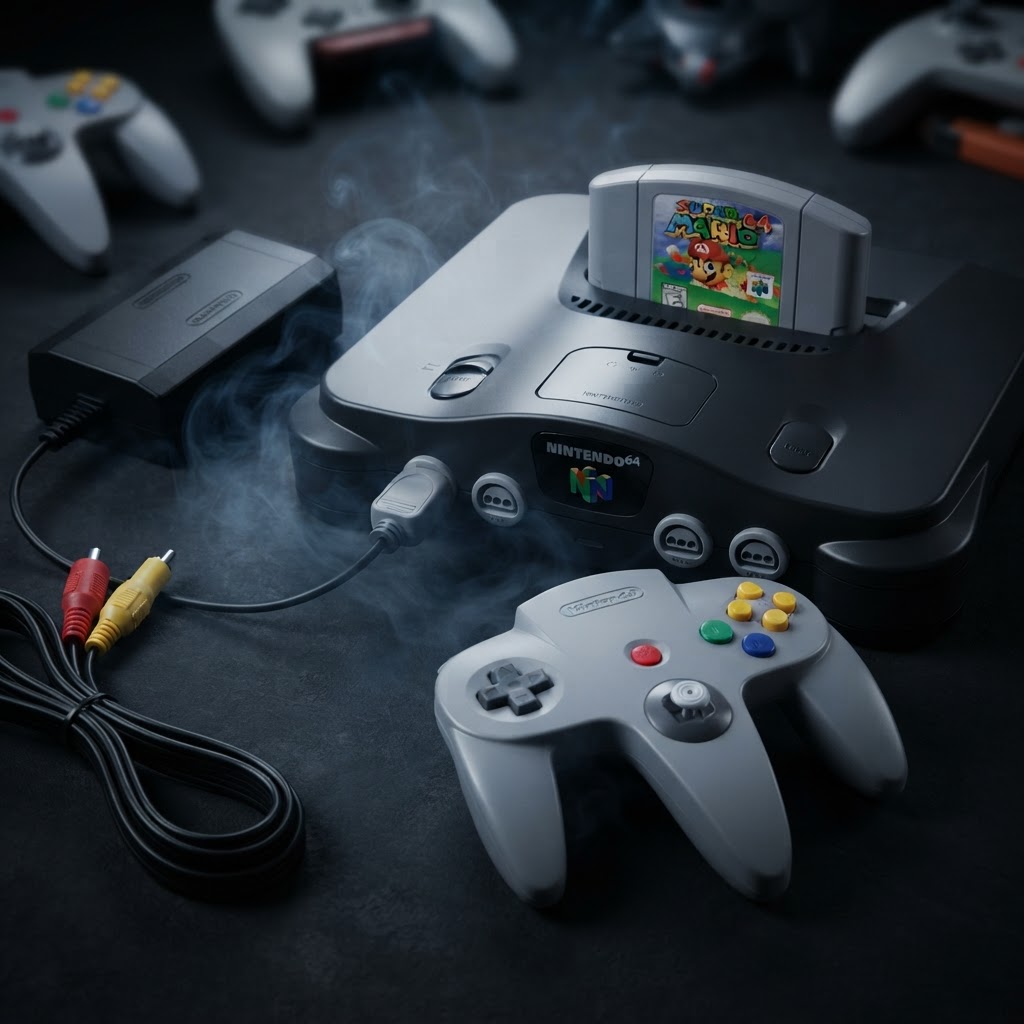
The Nintendo 64 is Nintendo's fifth-generation home video game console, released in North America on September 29, 1996, powered by a 64-bit NEC VR4300 CPU and a custom Reality Co-Processor that delivered real-time 3D graphics unprecedented in a home system at that price point. That single-sentence definition matters because the N64 is still regularly confused with its contemporaries — the Sony PlayStation and the Sega Saturn — by buyers entering the retro market for the first time in 2026.
What made the Nintendo 64 distinct was its unified memory architecture using Rambus DRAM, which gave developers faster memory bandwidth than the PlayStation's slower VRAM setup. It was also the first mainstream console to ship with an analog thumbstick as a standard controller feature, not an optional peripheral. That stick enabled Super Mario 64's 360-degree movement — a design decision Nintendo EAD's Shigeru Miyamoto has described as the central engineering challenge of the platform. Every game in the N64 library was built around that capability, from The Legend of Zelda: Ocarina of Time's Z-targeting system to the drifting mechanics in Mario Kart 64.
The console's trident-shaped controller was itself a product of uncertainty. Nintendo's engineers weren't sure whether players would use the analog stick or the traditional D-pad for any given game, so they designed a controller that accommodated both grips — one hand on the left prong for D-pad use, or one hand on the center prong for analog play. In practice, nearly every major title used the center-and-right configuration, which is why you almost never see someone using the N64 controller's left prong in normal gameplay. It's an unusual piece of hardware history that reflects just how genuinely new 3D gaming felt in 1996.
At NicestFinds, we handle N64 hardware regularly, and one thing we can tell you from experience: the black colorway is the standard North American NTSC-U revision, and it is the most compatible with the widest range of accessories and cartridges on the current market. The charcoal grey and atomic purple variants were regional or limited releases and are harder to source replacement parts for.
What Does the Black N64 Bundle Actually Include?
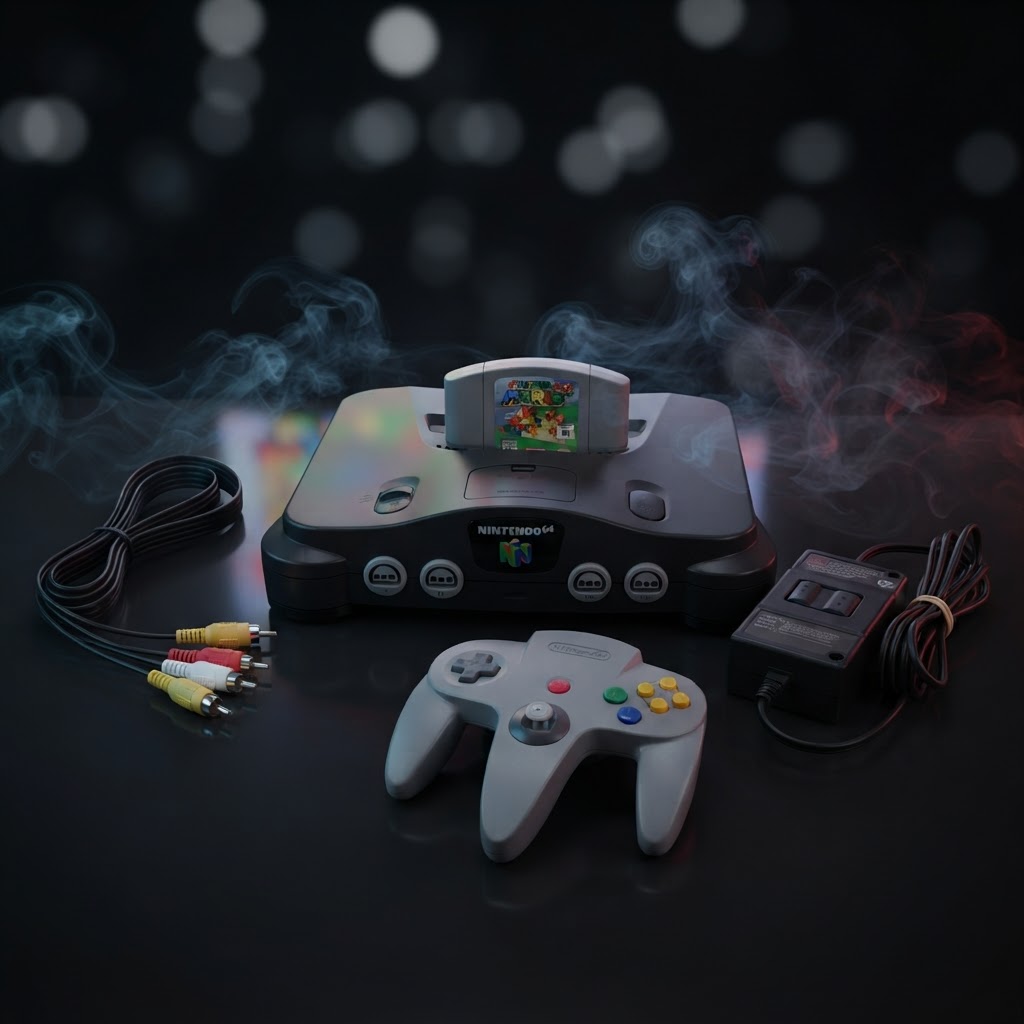
The Nintendo 64 Console Black - (N64) at $149.95 ships with three items: the console itself in its signature black finish, an AC power adapter, and a composite AV cable. Controllers and game cartridges are not included. That is worth stating plainly, because the most common support question we receive after an N64 order arrives is some variation of "where is the controller?" The original Nintendo 64 retail box did include a controller, but sourcing complete original bundles in 2026 reflects a different market reality than 1996, and pricing a bundle to include a controller would push this well beyond the $149.95 price point without necessarily giving you the controller color or condition you actually want.
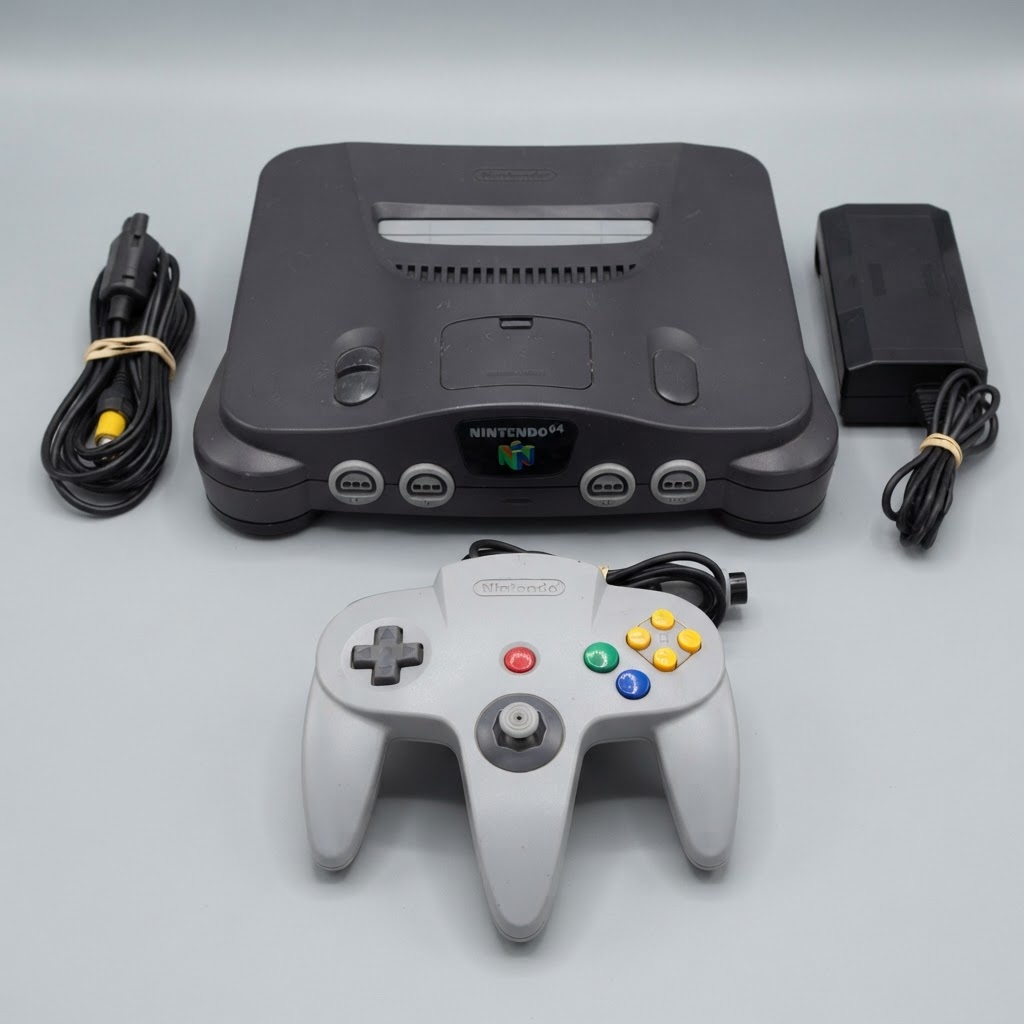
The composite AV cable included is a standard multi-out cable compatible with the N64's proprietary multi-out port — the same port design Nintendo used across the Super Nintendo and GameCube, which is why aftermarket cables are readily available and inexpensive. The AC power adapter is the correct voltage for North American outlets. Every console goes through a thorough inspection process before it ships, so what you receive is prepared hardware, not untested stock pulled from a storage bin.
One practical note: the N64's cartridge slot is on the top of the unit, and the cartridges insert with a firm downward push and a satisfying click. If a game isn't reading on first insertion, the most common fix is simply removing the cartridge, blowing briefly on the contacts, and reinserting. The cartridge-based format that Nintendo chose over CD-ROM — partly for load time advantages and partly for piracy resistance — means there are no moving optical parts to wear out, which is one reason N64 hardware has aged more reliably than disc-based systems from the same era.
Is the Nintendo 64 Console Worth Buying in 2026?
The honest answer depends on what you're looking for. If you want to play N64 games with maximum visual fidelity, the Nintendo Switch Online + Expansion Pack service offers a growing selection of N64 titles at subscription pricing with upscaled output. But if you want to play the full library of 387 licensed N64 titles — including games that have never appeared on any subscription service and likely never will due to licensing complexities — original hardware is your only reliable option.
Games like GoldenEye 007, for instance, spent decades in licensing limbo between Nintendo, Rare, and the Bond rights holders before a version finally came to Nintendo Switch Online in 2023. But dozens of other titles from publishers that no longer exist, or with music and sports licensing that has lapsed, remain accessible only on original cartridges. If you want to play NFL Blitz, WWF No Mercy, or Excitebike 64 in any form today, you need an N64. The same is true of the full Rare library in its original form, including Banjo-Tooie, Conker's Bad Fur Day, and Jet Force Gemini.
Beyond library access, there is also the question of the experience itself. The N64 controller's analog stick, the weight of the cartridges, the particular audio output of the system's sound chip — these are not things that emulation fully replicates. For players who grew up with the platform, playing on original hardware carries a tactile and sensory dimension that matters. For younger collectors encountering the library for the first time, original hardware provides a historically authentic context that enhances rather than replaces the games themselves.
How Much Should I Pay for a Nintendo 64 Console?
The secondary market for N64 hardware fluctuates based on condition, completeness, and the platform's ongoing cultural relevance. As of 2026, a console-only unit in working condition without any accessories typically appears in the $80–$120 range through private sellers, while complete bundles with a controller, power supply, and AV cable in good cosmetic condition generally fall between $130 and $180. The $149.95 price point at NicestFinds for a console that has been inspected and includes a power adapter and AV cable sits squarely within that established market range.
What you are paying for beyond the hardware itself is the preparation and accountability that comes with purchasing from a dedicated retailer rather than a private party. Buying an N64 from an individual seller carries real risks — power supplies can fail in ways that damage the console, AV cables can have intermittent connections that are difficult to diagnose, and consoles can have internal issues that only manifest after hours of play. Purchasing from a retailer that inspects its hardware before sale provides a degree of confidence that the $10 or $20 you might save buying privately does not necessarily justify.
Do You Need a Replacement Power Supply or AV Cable?
If you're setting up an N64 for the first time and the included accessories are functioning correctly, you don't immediately need additional cables. However, it's worth knowing that both a Replacement AC Power Supply for Nintendo 64 Console ($21.95) and a Universal AV Composite Cable for Nintendo 64 / SNES / GameCube ($9.95) are available separately. Having a spare power supply in particular is sensible if you plan to use the console regularly. Original N64 power supplies are now nearly thirty years old, and while they are generally robust, a failed power supply is the most common hardware failure point on the platform.
The universal AV cable is also a worthwhile backup. The multi-out connector is a shared standard across the SNES and GameCube, so a single cable can serve multiple Nintendo consoles from that era. If you're building a retro setup with more than one Nintendo platform, having a spare composite cable on hand saves you from cable-swapping every time you switch systems.
What's the Difference Between Composite and HDMI on an N64?
The N64 outputs video through its multi-out port using a composite signal, which combines the color and brightness information of the image into a single channel. This was the standard consumer video connection in 1996, and it works correctly with televisions that have composite (yellow RCA) inputs. The problem in 2026 is that most modern flat-panel televisions have eliminated composite inputs entirely in favor of HDMI, which carries a digital signal at much higher resolutions.
Bridging the gap requires an AV-to-HDMI adapter, which converts the analog composite signal from the N64 into a digital HDMI signal your television can accept. These adapters are widely available for under $20 from electronics retailers. The image quality through a basic composite-to-HDMI adapter will reflect the composite source — it will look like composite video, upscaled. For many players, this is perfectly acceptable. For those who want a significantly sharper image, more advanced options exist, including component video cables (which require the N64's digital-analog converter chip to be unlocked via a specific cable), and dedicated upscalers like the Retrotink 2X or higher-end units that perform frame-by-frame processing. These options represent a meaningful cost investment beyond the console itself, but they transform the visual output significantly for players using large modern displays.
Which N64 Games Should You Play First?
For a player new to the platform, the N64 library has a handful of titles that defined not just the console but the medium itself. Super Mario 64 is the obvious starting point — it invented the template for 3D platformers and remains a genuinely brilliant game by any standard. The Legend of Zelda: Ocarina of Time is frequently cited by critics and developers as one of the most influential games ever made, introducing the lock-on targeting system and narrative structure that action-adventure games still follow today.
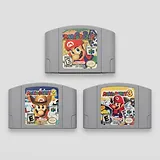
Beyond those two landmarks, the multiplayer catalog is where the N64 truly distinguished itself from every other platform of its era. Mario Kart 64 introduced the four-player split-screen format that the series still uses. GoldenEye 007, developed by Rare and released in 1997, essentially created the template for console first-person shooters. Super Smash Bros., released in 1999 as the final major Nintendo first-party title on the platform, launched one of Nintendo's most enduring franchises. Banjo-Kazooie, also from Rare, offered a collectible platformer that rivaled Mario 64 in ambition and charm. For players interested in racing, F-Zero X remains one of the fastest and most technically impressive games on the system.
The N64 library also contains some of the most sought-after and expensive cartridges in retro collecting. Conker's Bad Fur Day, an M-rated platformer from Rare released in 2001 as one of the console's last major titles, routinely commands over $100 for a cartridge alone. Paper Mario, Majora's Mask, and Donkey Kong 64 are all titles that have appreciated significantly on the secondary market, making early investment in the library a reasonable collecting strategy.
How Does the N64 Compare to Its Fifth-Generation Rivals?
The fifth generation of home consoles — roughly 1994 to 2002 — was defined by the transition from 2D sprite-based games to 3D polygon graphics, and three platforms contested that transition most visibly: the Sony PlayStation, the Sega Saturn, and the Nintendo 64. Each took a meaningfully different approach.
The Sony PlayStation launched in North America in September 1995, a full year before the N64, and its CD-ROM format gave it a significant advantage in terms of storage capacity and publisher adoption. The PlayStation's library was broader and included genres — JRPGs in particular — that the N64 never captured effectively. The N64's cartridge format, while excellent for load times and durability, limited storage to what could fit on a ROM chip, which constrained the kind of large-scale, dialogue-heavy games that defined the PlayStation's catalog. Final Fantasy VII, released for PlayStation in 1997, was originally in development for the N64 before Square moved it to Sony's platform specifically because cartridge storage was insufficient for the game's scope.
The Sega Saturn, by contrast, struggled with 3D performance and developer support throughout its lifespan, and it was effectively discontinued in North America by 1998. The N64 outlasted it comfortably and accumulated a first-party library that the Saturn could not match.
Where the N64 excelled over both rivals was in first-party software quality and multiplayer capability. Nintendo's four controller ports, built into the console rather than added via a peripheral, made it the definitive party gaming platform of its generation. No PlayStation or Saturn game could match the social experience of four players in Mario Kart 64 or GoldenEye 007 in a living room setting, and that social dimension remains central to the N64's nostalgic identity in 2026.
Frequently Asked Questions
Does this console play games from other regions? This unit is designed for NTSC-U game cartridges.
How do I save my game progress? Progress is managed either through internal game memory or via a Controller Pak inserted into the back of your controller.
Can I use this on a modern HDTV? Yes, though you will likely need an AV-to-HDMI adapter to bridge the connection between the console's multi-out port and your television's HDMI input.
What is the MSRP for this console? As a vintage system, pricing varies based on market availability rather than a fixed manufacturer's suggested retail price.